
You did not cause the crash. You are sure of it. But the other driver tells the officer a different story, and now their version of events is sitting in the police report next to yours, word for word, with nothing to separate the two except who sounded more convincing on the side of the road.
This is one of the most common and most frustrating situations we see in personal injury claims. In North Carolina, where even a small share of fault can bar you from recovering anything at all, a dispute over who caused the crash is not just inconvenient. It can be the entire case. Dash cam evidence is one of the simplest, most affordable tools a driver can use to make sure that dispute never happens in the first place.
What Dash Cam Evidence Actually Does for a Car Accident Claim
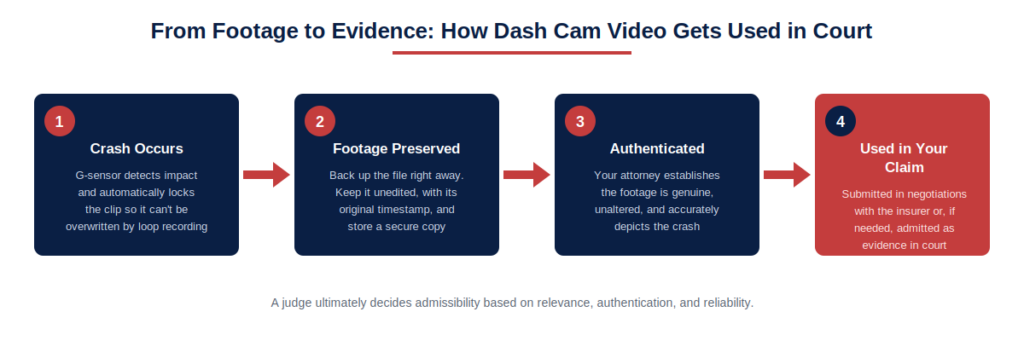
A dash cam is a small camera that mounts to your windshield or dashboard and records continuously while you drive, saving footage in short looped clips. Most models automatically lock and save a clip when they detect a sudden impact, so the footage from the moments before and after a crash is preserved even if you never touch the device.
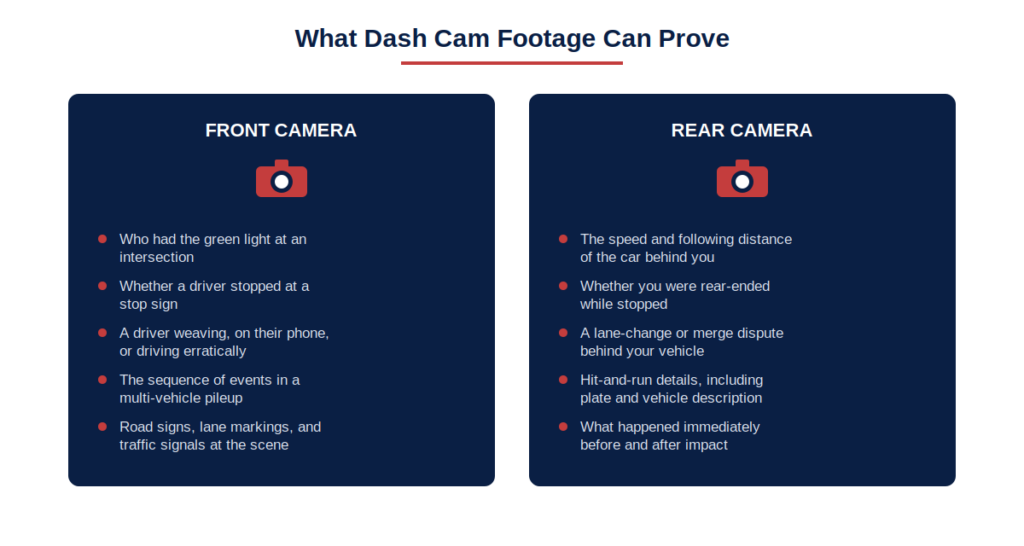
For a car accident claim, dash cam evidence becomes an objective record of what actually happened. It can show:
- Who had the green light at an intersection
- Whether a driver came to a complete stop at a stop sign
- The speed and following distance of the vehicle behind you
- Whether a driver was on their phone, weaving, or driving erratically
- The exact sequence of a multi-vehicle pileup, which is often the hardest type of crash to sort out after the fact
When liability is contested, this kind of footage can be the difference between a fair settlement and a fight that drags on for months.
Why Dash Cam Evidence Matters More in North Carolina Car Accident Cases
North Carolina is one of only a small handful of states that still follows the doctrine of contributory negligence. Under this rule, if you are found even slightly at fault for a crash, even one percent, you can be barred from recovering any compensation at all, regardless of how much more at fault the other driver was.
This makes North Carolina a uniquely difficult place to be in a “he said, she said” crash. Insurance adjusters know the contributory negligence rule too, and they actively look for any plausible way to shift even a small percentage of blame onto you, because doing so can end your claim entirely. Strong dash cam evidence showing the other driver ran the light, failed to yield, or rear-ended you while distracted removes the ambiguity that adjusters rely on to make that argument.
Is Dash Cam Evidence Admissible in North Carolina Car Accident Cases?
Yes. North Carolina has no statute that specifically regulates dash cams, but courts have made clear they are willing to admit this kind of footage. For dash cam evidence to be used in a car accident case, the video generally needs to meet three standards:
Relevance. The footage has to actually relate to the crash or the events leading up to it.
Authentication. You need to be able to show the video is genuine and has not been edited or altered. This is why it matters to back up footage immediately and avoid the loop-recording feature accidentally overwriting the clip you need.
Reliability. Courts look at whether the footage is clear, properly time-stamped, and presented as a complete, unedited sequence rather than a selectively cut clip.
Opposing counsel can object to dash cam footage on any of these grounds, which is exactly why it helps to have an attorney who knows how to properly preserve, authenticate, and present this kind of evidence rather than just handing over a memory card and hoping for the best.
One Important Caveat: It Can Also Show Your Mistakes
A dash cam captures everything in its frame, not just the other driver’s behavior. If you were going a little over the speed limit, didn’t use a turn signal, or were on a call when the crash happened, the same footage that could clear you could also be used against you. This cuts both ways, and it is worth knowing that going in. In our experience, the benefit of having an objective record overwhelmingly outweighs this risk for the vast majority of drivers, but it is not a one-sided tool, and you should drive the same whether the camera is rolling or not.
What to Look For in a Front and Rear Dash Cam
You do not need a professional installation or an expensive system to get meaningful protection. Most modern dash cams are designed for a driver to install in well under an hour, using factory gaps along the headliner and door trim to hide the cable running from the front unit to the rear camera. A few things worth prioritizing when choosing one:
Front and rear coverage. A front-only camera only tells half the story. Rear-end collisions and lane-change disputes need a rear-facing camera to be useful.
At least 1080p resolution on both cameras. You want footage clear enough to read a license plate or see a traffic signal, not a blurry approximation of what happened.
A capacitor instead of a battery, if you can find one. Dash cams live through North Carolina summers inside a hot car, and devices with built-in batteries degrade faster in that heat. Supercapacitor-based models tend to hold up better over time.
Automatic incident locking (a G-sensor). This is the feature that detects a sudden impact and automatically saves that clip so it cannot be overwritten by ordinary loop recording.
A long enough rear camera cable. Check that the cable length matches your vehicle. Most kits include a cable in the 16 to 20 foot range, which covers the majority of sedans and SUVs.
Several well-reviewed two-camera systems are sold directly on Amazon in the $150 to $300 range and are designed for straightforward, tool-light self-installation. Budget options with basic front-and-rear recording and G-sensor locking start closer to $100, while mid-range systems add features like GPS tagging, sharper night vision, and faster Wi-Fi for pulling footage to your phone.
A Few Legal Housekeeping Notes
North Carolina does not restrict where you mount a dash cam, but general windshield obstruction law still applies, so the device should not block your view of the road. Most drivers mount the front unit low, near the rearview mirror, where it is out of the direct line of sight.
North Carolina is also a one-party consent state for audio recording, meaning you are allowed to record audio inside your own vehicle since you are a participant in any conversation happening there.
If You’re in a Crash, Dash Cam or Not
Whether or not you have footage, the same steps protect your claim: get medical attention promptly, document the scene if it is safe to do so, exchange information with the other driver, and be careful about what you say to any insurance adjuster, including your own, before you understand the full picture of your injuries. If you do have dash cam footage, back it up immediately. Do not wait, and do not let the device’s loop recording record over the clip you need.
If you’ve been in a crash and aren’t sure what your footage shows or how it affects your claim, RMN Law can help you understand your options.
Rachel M. Noorthoek is the founder of RMN Law, PLLC, a personal injury firm based in Mooresville, North Carolina. She has more than 20 years of litigation experience representing injured clients across North Carolina, South Carolina, and federal courts. She is a member of the Million Dollar Advocates Forum and Multi-Million Dollar Advocates Forum.
(704) 237-0446 | [email protected] | rmninjurylaw.com