
Charlotte adopted Vision Zero in 2019 with a clear promise: eliminate traffic deaths and serious injuries on city streets. Seven years later, the data tells a harder story. Crashes overall are down. But the crashes that are happening are killing more people, and pedestrians are absorbing a disproportionate share of that harm.
What the Latest Numbers Show
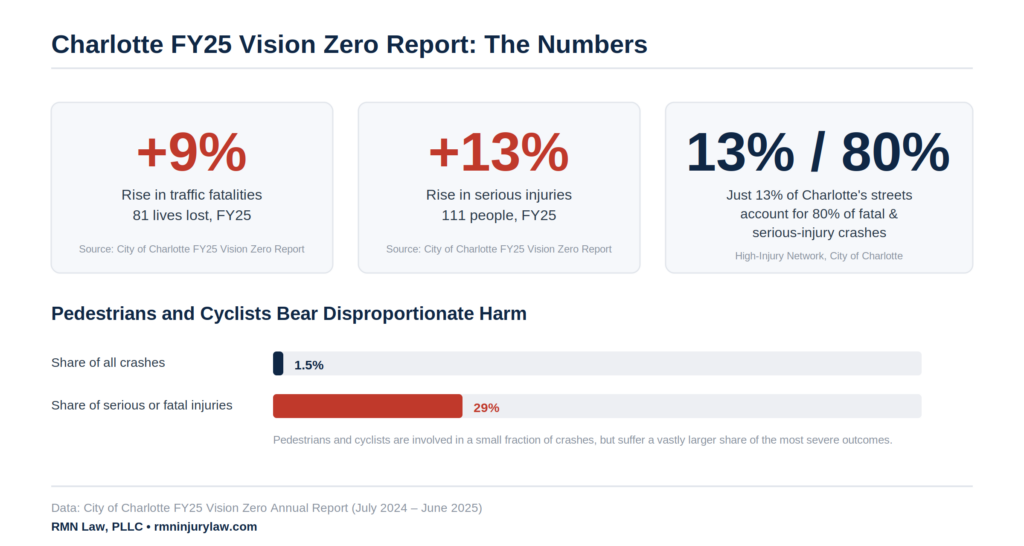
The City’s FY25 Vision Zero Annual Report (covering July 2024 through June 2025) found a troubling pattern: overall crash counts fell, but traffic fatalities rose 9%, to 81 lives lost, and serious injuries climbed 13%, to 111 people. Pedestrians and cyclists made up only 1.5% of all crashes citywide, but accounted for 29% of all serious or fatal injuries.
That gap matters. It means the danger isn’t spread evenly across every kind of crash. It’s concentrated on the people with the least protection: someone crossing a street, walking to a bus stop, or biking home from work.
The report also confirmed something Charlotte safety advocates have flagged for years: just 13% of the city’s streets account for 80% of all fatal and serious-injury crashes. This stretch of roadway is known as the High-Injury Network, and it includes some of the city’s busiest corridors: Independence Boulevard, North Graham Street, Freedom Drive, and Wilkinson Boulevard among them.
Why Some of the Most Dangerous Roads Are the Hardest to Fix
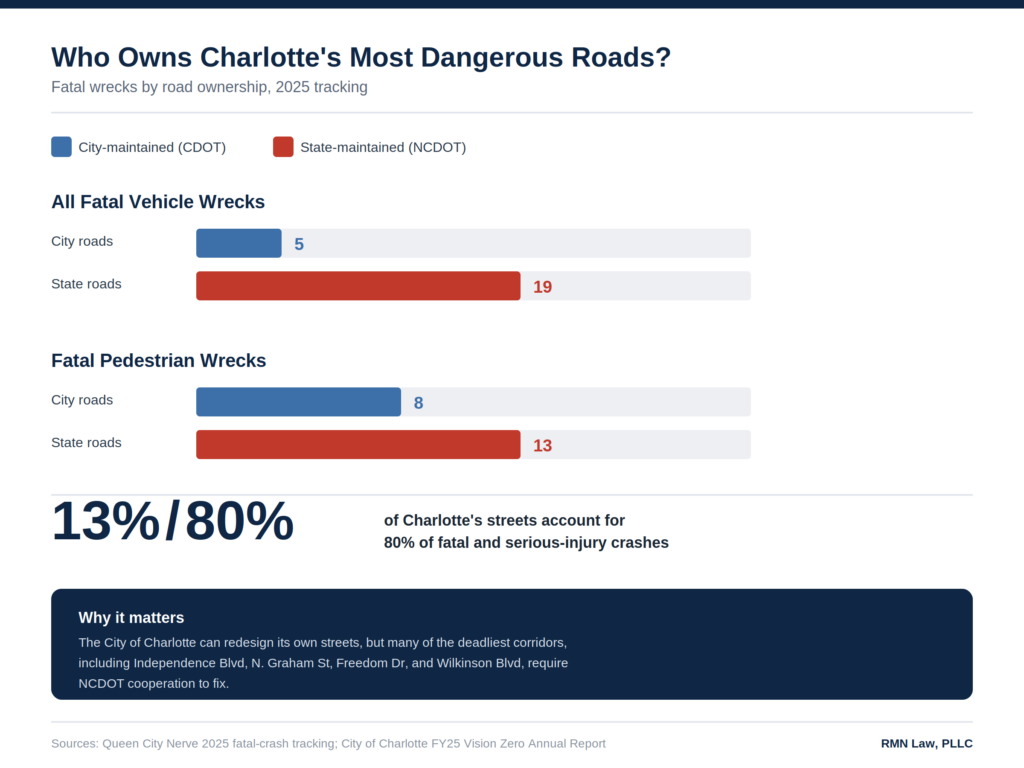
Here’s a frustrating wrinkle in Charlotte’s Vision Zero effort: many of the city’s most dangerous corridors aren’t actually controlled by the city. They’re maintained by the North Carolina Department of Transportation (NCDOT). That means Charlotte’s own street-redesign tools (narrower lanes, raised crosswalks, protected bike lanes) can’t be applied without state cooperation, and that cooperation hasn’t always come quickly.
Local tracking has found a stark divide: a recent year saw far more fatal pedestrian wrecks on state-maintained roads than on city-maintained ones. When the agency that owns the pavement isn’t moving at the same pace as the agency setting the safety policy, dangerous intersections can stay dangerous for years.
Who Is Bearing the Brunt
The data also points to disparities that go beyond geography. Reporting on Charlotte’s 2025 figures found that Black residents, who make up roughly a third of the city’s population, accounted for a notably higher share of crash injuries and deaths. Men were also overrepresented among those seriously or fatally injured relative to their share of the population.
These patterns aren’t unique to Charlotte, but they underscore that “Vision Zero” isn’t an abstract policy goal. It’s a measure of whose neighborhoods have safe infrastructure and whose don’t.
What’s Changing, and What Isn’t
To be fair, there has been real investment. Charlotte voters approved a $400 million transportation bond in late 2024 that dedicated $20 million specifically to Vision Zero projects. In November 2025, Mecklenburg County voters went further, approving a one-cent sales tax that will direct 40% of its revenue toward road improvements. City crews have installed new pedestrian hybrid beacons, rectangular rapid-flashing beacons, leading pedestrian intervals, and traffic signals at known trouble spots.
But advocates argue that signage and beacons only go so far. Sustain Charlotte, which co-chairs the city’s Vision Zero Task Force, has been blunt about the disconnect: the policy says human life comes first, but the streets where people are dying largely remain unchanged. Their call for FY26 is for the city to move past low-cost fixes and toward genuine road redesigns (narrower travel lanes, protected bike infrastructure, raised crosswalks) on the corridors doing the most harm.
What This Means If You’ve Been Hurt
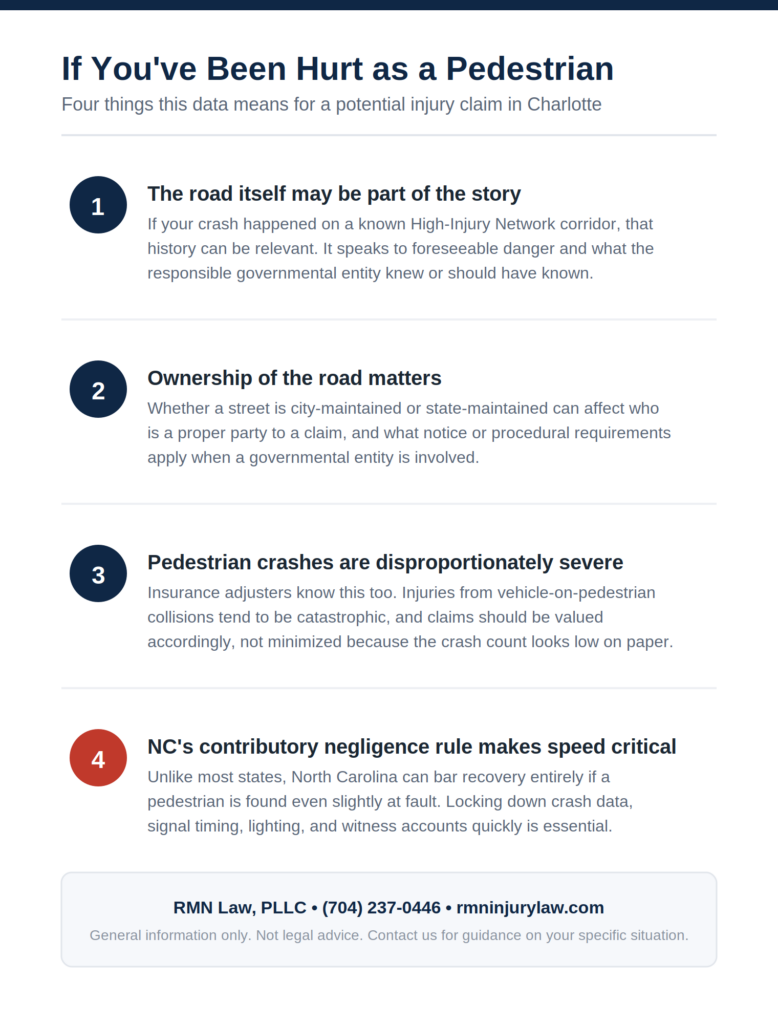
If you or someone you love has been struck while walking, running, or biking in Charlotte, a few things from this data are worth keeping in mind:
Charlotte Deserves Safer Streets, and Injured Pedestrians Deserve Answers
Year seven of Vision Zero is a reminder that policy goals and street-level reality don’t always move together. Until Charlotte’s infrastructure catches up to its stated ambitions, pedestrians will keep absorbing a disproportionate share of the risk on local roads.
If you’ve been injured as a pedestrian or cyclist in Charlotte or anywhere in the Lake Norman area, RMN Law is here to help you understand your options and pursue the compensation you deserve.
This article is for general informational purposes and does not constitute legal advice. Every case is different. Contact RMN Law for guidance specific to your situation.
RMN Law, PLLC (704) 237-0446 | [email protected] | rmninjurylaw.com